

Zhengheng Power | Why Are There Three Casting Methods—High-Pressure, Low-Pressure, and Gravity—for the Same Aluminum Alloy Part?
The same aluminum alloy part may end up on a high-pressure, low-pressure, or gravity casting production line. There is no hierarchy among these three methods; the actual choice depends on the part’s structure, performance, production volume, and subsequent machining and validation requirements.
Why might a single new drawing lead to three different production lines?
“Can this housing be produced using high-pressure die casting?” Many aluminum alloy component projects begin with questions like this. Although there appears to be only one drawing, the engineering team may propose three different approaches: high-pressure, low-pressure, or gravity casting. These are not simply categorized as high, medium, or low-end; rather, they involve different methods of introducing molten aluminum into the mold cavity, resulting in distinct filling patterns, solidification processes, and production rhythms.
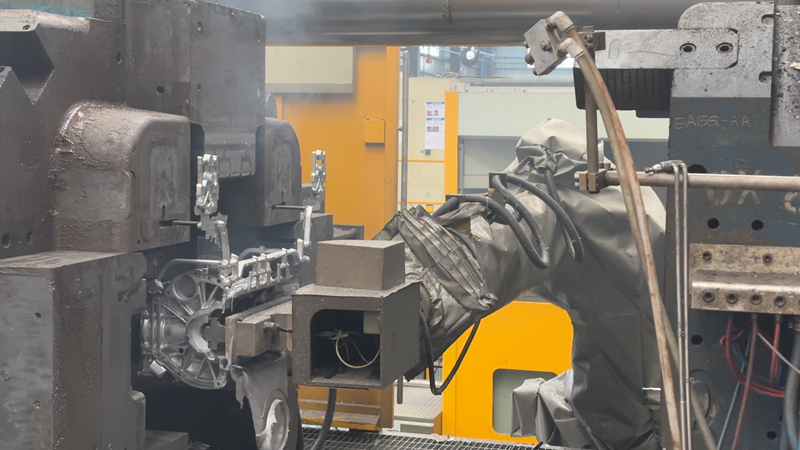
High-Pressure Die Casting: When Complex Thin-Walled Designs and Production Efficiency Are Priorities
High-pressure die casting injects molten aluminum into a metal mold at high speed and under high pressure. It is suitable for parts with complex contours, locally thin walls, a high degree of integration, and a certain production volume. Its advantages include high forming efficiency, good dimensional repeatability, and the ability to reduce some post-processing steps. However, “fast” does not mean it is suitable for all structures. The gating system, venting and vacuum designs, locally thick or large sections, and requirements for subsequent heat treatment or welding all need to be evaluated simultaneously in the early stages.
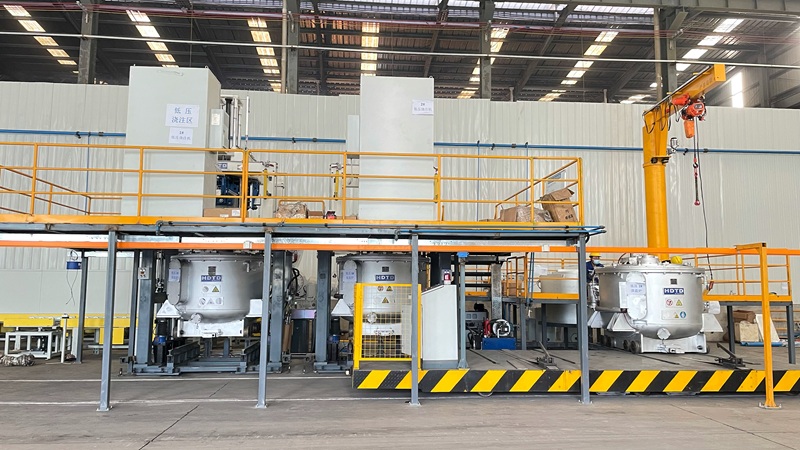
Low-Pressure Die Casting: Enabling a Smoother Filling Process for Molten Aluminum
Low-pressure die casting uses controlled pressure to allow molten aluminum to fill the mold smoothly from the bottom up. The filling process is relatively gentle, facilitating design considerations related to internal quality, feeders, and load-bearing requirements. For structural components with specific wall thicknesses, load-bearing requirements, or heat treatment needs, this process often offers greater design flexibility. However, low-pressure die casting is not a one-size-fits-all solution. Mold designs, sand core structures, solidification sequences, production cycles, and equipment investment must all be balanced against production volume and quality objectives.
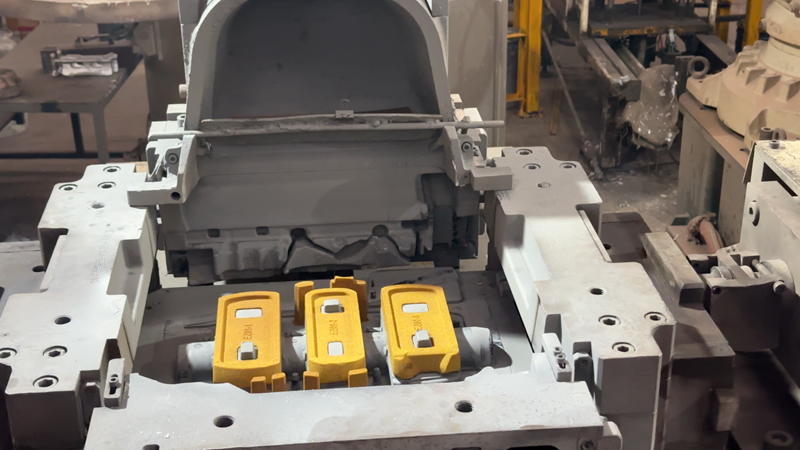
Gravity Casting: Flexible Design Capabilities, Capable of Stable Mass Production
Gravity casting relies on the weight of the molten aluminum itself to fill the mold, offering greater flexibility in mold and sand core design. It is suitable for medium-wall-thickness parts, complex internal cavities, prototyping, and high-variety production. On the fully automated gravity casting production line at Tonglin Casting, automatic pouring, temperature control, and process logging are integrated into a single production unit. Automation not only increases speed but also makes it easier to maintain consistency in operations that were previously dependent on experience, thereby paving the way for stable, high-volume production in gravity casting.
Three Production Pathways, All Serving the Same Product Goal
Zhengheng Power operates production lines for high-pressure, low-pressure, and gravity casting, and integrates product design, tooling, casting, and machining. The purpose of this multi-process layout is not to burden customers with memorizing additional process names, but to ensure that a single set of drawings can be evaluated based on structure, performance, quantity, and cost to identify the most suitable manufacturing pathway.
Post time: Aug-03-2026