

With the launch of an automated gravity casting production line, how can the stability of aluminum alloy castings be enhanced?
While gravity casting may appear traditional, achieving stable mass production requires the combined support of equipment, processes, and quality systems. Tonglin Casting has launched a new automated gravity casting cell, further boosting its capacity for the large-scale delivery of aluminum alloy components.
In the manufacturing of aluminum alloy components, high-pressure die casting, low-pressure casting, and gravity casting each have their own specific applications. Gravity casting relies on gravity to fill the mold with molten metal; it is suitable for a wide range of aluminum alloy parts and allows for the design of gating systems and cooling strategies tailored to specific product structures, wall thicknesses, and performance requirements.
Gravity casting offers unique value for products with complex structures, stringent internal quality requirements, or those requiring flexible batch sizes. However, the process is sensitive to factors such as molten metal quality, mold temperature, the pouring process, and solidification sequence. Fluctuations in any of these areas can lead to defects like cold shuts, porosity, shrinkage, or dimensional deviations. Therefore, achieving high-quality mass production in gravity casting hinges on process stability.
**Automation Primarily Addresses “Consistency”**
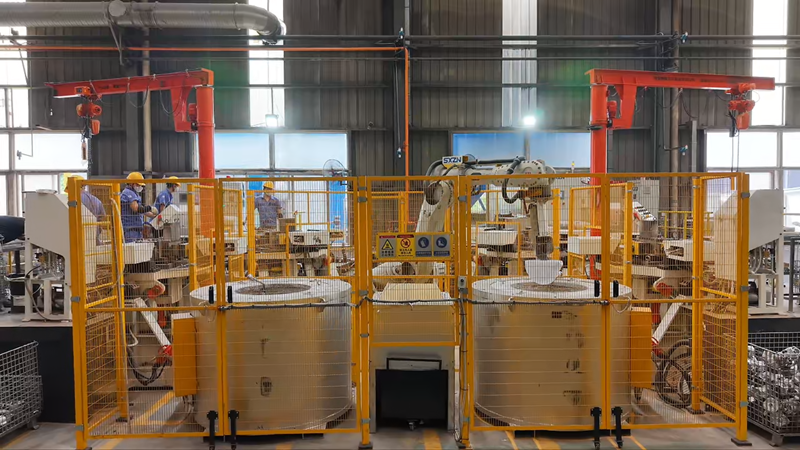
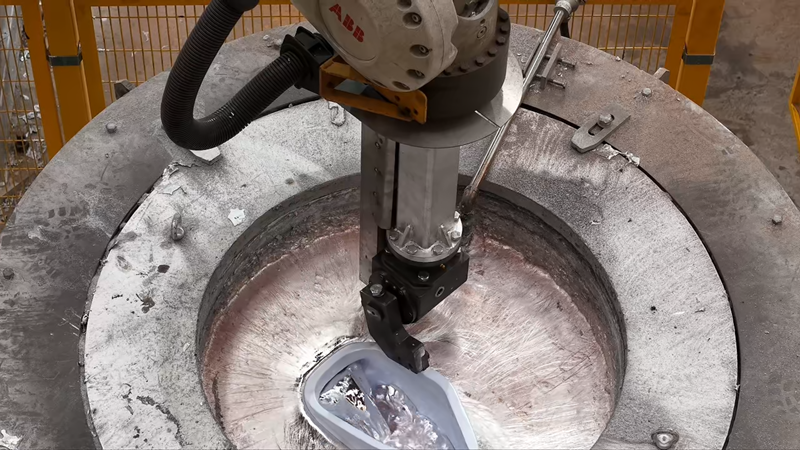
Tonglin Casting, a wholly-owned subsidiary of Zhengheng Power, has successfully commissioned and launched a new automated gravity casting cell. Leveraging an automated equipment architecture and a precision hydraulic pouring system, the production line drives the automation of the aluminum alloy gravity casting process.
Automation offers more than just increased speed; crucially, it minimizes variability caused by differences between shifts or operators. By stabilizing pouring actions, cycle times, and process parameters, the system ensures consistent mold-filling conditions, providing a more reliable foundation for subsequent solidification control and product quality.
**Achieving Casting Stability Requires Coordination Across Multiple Stages**
The quality of aluminum alloy gravity castings cannot be ensured by a single piece of equipment alone. Upstream processes require control over raw materials, melting, and degassing/refining; mid-stream operations involve the optimized design of mold temperature control, gating systems, and cooling sequences; and downstream stages require verification through cleaning, heat treatment, inspection, and machining.
This is particularly critical for products such as housings, brackets, and components with complex internal cavities, where localized variations in wall thickness can lead to asynchronous solidification. Engineering teams must continuously optimize processes based on structural analysis and trial production data, making adjustments—such as modifying fillets, wall thickness transitions, or machining allowances—at the product design stage when necessary. Only when equipment, processes, molds, and quality inspection form a closed-loop system can an automated production line consistently deliver stable products.
**Flexible Delivery Capabilities Across Multiple Industries**
The application of aluminum alloy components has expanded beyond traditional automobiles into sectors such as new energy vehicles, high-end motorcycles, aviation, marine engineering, and construction machinery. As customer requirements regarding batch sizes, materials, dimensions, and performance vary significantly, suppliers must possess not only mass production capabilities but also the ability to introduce new products and switch between manufacturing processes.
Zhengheng Power has established a diverse process portfolio—encompassing high-pressure die casting, low-pressure casting, and gravity casting—and offers one-stop services ranging from design, mold making, and casting to machining. The launch of this automated gravity casting line marks a significant step in the continuous upgrading of the company’s manufacturing capabilities, further strengthening its ability to ensure consistent quality, production efficiency, and stable delivery of aluminum alloy components.
Post time: Jul-31-2026