

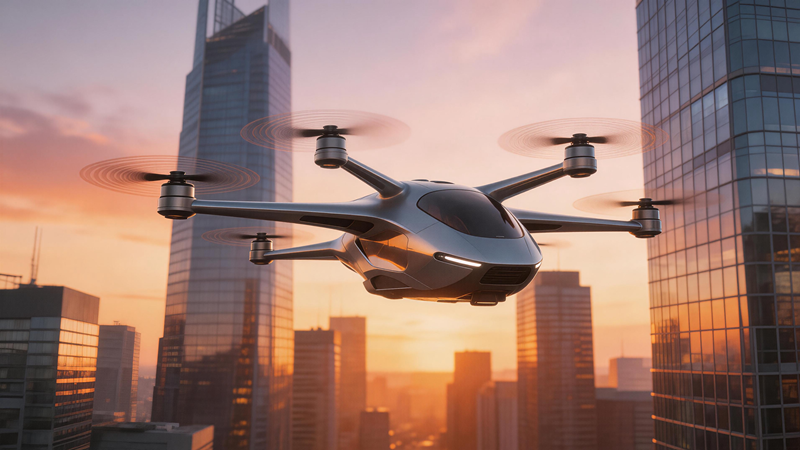
With the gradual advancement of the national low-altitude opening policy, the low-altitude economy has become a new growth pole driving industrial upgrading. However, its true core track is not the consumer-grade drones that are well-known to the public, but rather eVTOLs (electric vertical take-off and landing vehicles). This new type of vehicle, which requires no runway and can take off and land flexibly, is rapidly being implemented in scenarios such as air commuting, emergency rescue, low-altitude logistics, and sightseeing tourism, becoming a key carrier for the industrialization of the low-altitude economy.
The propulsion system is the “heart” of an eVTOL. The performance and reliability of its core components directly determine the aircraft’s endurance, payload, and safety, and are also the core bottleneck for breakthroughs in the low-altitude economy.
The essence of the low-altitude economy lies in breaking down barriers in low-altitude space and achieving three-dimensional transportation and efficient logistics. As the core carrier, eVTOL stands out from traditional aircraft and automobiles due to its essential differences:
Vertical take-off and landing (VTOL): No runway required, can be deployed on rooftops, helipads, or small venues
Electric drive: more environmentally friendly, lower noise, meeting urban operation requirements
Intelligentization + Autonomous Driving: Laying the Foundation for Future Air Travel
It is precisely these characteristics that make eVTOLs impose requirements on power components that far exceed those of traditional automobiles.
Traditional automotive components focus on “high temperature resistance and load resistance”, while eVTOL power components must simultaneously meet three extreme requirements:
1. Ultimate lightweight
The payload capacity of an aircraft is extremely valuable, and every 1kg reduction in weight can increase the endurance by 5%–8%. This has compelled a comprehensive upgrade in materials and structures: lightweight materials such as aluminum alloy, magnesium alloy, and titanium alloy, as well as thin-walled, hollow, and integrated structures, have become standard.
2. Ultra-high reliability
The high-altitude environment is complex, featuring temperature differences ranging from -40℃ to 80℃, strong vibrations, and airflow disturbances. Power components must achieve thousands of hours of trouble-free operation. Ground vehicle malfunctions can be rescued, but airborne failures have serious consequences. Reliability is the bottom line.
3. Ultimate miniaturization
The eVTOL (Electric Vertical Take-Off and Landing) aircraft has a compact body and limited space, requiring highly integrated components and integrated complex structures to achieve high performance within a very small volume.
To simultaneously achieve lightweight, high precision, and high reliability, two advanced manufacturing technologies serve as enablers:
1. 3D printing sand mold technology
Without the need for traditional molds, sand molds can be directly printed, reducing the research and development cycle by over 40%. This is suitable for the development of power components with complex structures, ensuring both accuracy and molding efficiency.
2. Plasma cylinder hole thermal spraying technology
Surface strengthening is applied to key friction surfaces such as cylinder bores, significantly enhancing wear resistance, corrosion resistance, and high-temperature tolerance. This enables components to adapt to harsh working conditions in high altitudes and provides support for mass production.
The breakthrough in power components for eVTOLs is a prerequisite for the commercialization of the low-altitude economy. In the future, as lightweight materials, precision casting, and advanced machining technologies continue to mature, the power system will achieve performance upgrades and cost reductions, driving the low-altitude economy to truly enter people’s lives.
As a technology-driven enterprise with over two decades of experience in precision casting, Zhengheng Power boasts extensive expertise in lightweight aluminum alloy casting and complex structural precision molding. Its technologies, including high-pressure casting, precision machining, and surface treatment, have been extensively applied in the field of new energy vehicles.
Relying on mature technical reserves and manufacturing capabilities, Zhengheng Power is capable of providing lightweight, high-strength, and high-reliability castings for eVTOL power systems. With ground-based hardcore manufacturing, it supports the safe “takeoff” of the low-altitude economy.
Post time: Feb-17-2026